
What Does MVP Mean? Definition, Benefits, Examples & Complete Guide
Learn what a Minimum Viable Product is, its benefits, examples, and how MVPs help validate ideas.

Satyam Hardiya
September 2, 2026
What Does MVP Mean? Definition, Benefits, Examples & Complete Guide
If you have a software idea, you may have heard someone say, "You should build an MVP first." But what does MVP mean, and what does it actually involve?
In business and software development, MVP stands for Minimum Viable Product. It is an early, usable version of a product that includes enough of the right features to solve a core customer problem and test the idea with real users. The goal is not simply to build something quickly or cheaply. It is to learn whether the product is solving a real problem before investing heavily in the full product.
An MVP can help founders and product teams test assumptions, understand customer needs, collect feedback, and make better product decisions. The approach is widely associated with lean product development and iterative learning.

For example, a startup planning a complete logistics platform may not need to build every planned feature on day one. It might start with shipment creation, order tracking, and basic notifications. If customers use those features and the business learns something useful from them, the team has a foundation for deciding what to build next.
The important point is simple:
An MVP is not about building the fewest features. It is about building enough of the right product to test an important business assumption.
What Is a Minimum Viable Product?
A Minimum Viable Product, or MVP, is an initial version of a product that provides enough value for early users while allowing the business to test its core idea in the real world.
A good MVP generally has five characteristics:
- It solves a clearly defined problem.
- It focuses on a specific type of user.
- It includes only the features needed to deliver the core value.
- It can be used or tested by real users.
- It generates feedback that can guide future development.
The word "minimum" is often misunderstood. It does not mean that an MVP should be poorly designed, unstable, or full of bugs.
A well-built software MVP can still include secure authentication, a reliable backend, proper database design, quality assurance, analytics, error handling, and a clean user experience.
What is reduced is the scope, not the quality.

What Does "Minimum" Mean?
"Minimum" means building the smallest practical scope that can answer an important product question.
For example, imagine a founder wants to build a marketplace for construction companies to hire specialist contractors.
The full product might eventually include:
- Contractor profiles
- Search and filtering
- Job posting
- Messaging
- Payments
- Reviews
- Notifications
- AI matching
- Reporting
- Mobile applications
- Admin tools
An MVP may not need all of these.
The first version might focus only on:
Post a job → Find a suitable contractor → Contact the contractor
That smaller scope allows the team to test whether customers actually need and use the marketplace before building everything else.
What Does "Viable" Mean?
"Viable" means the product must provide enough value to be useful.
If you remove so many features that users cannot complete the main task, the product is no longer viable.
For example, a food delivery MVP does not necessarily need loyalty points, restaurant advertising, advanced recommendations, or multiple payment options.
But users still need a way to:
- Find a restaurant.
- Select food.
- Place an order.
- Receive confirmation.
The MVP must make the core experience work.
What Does "Product" Mean?
The word "product" does not necessarily mean a large, finished application.
An MVP can be:
- A web application
- A mobile app
- A SaaS platform
- A marketplace
- An internal business system
- A customer-facing service
- A new feature within an existing product
The format depends on what the business needs to learn.
What Does MVP Mean in Business?
In business, an MVP is a way to test whether an idea has enough real-world value before making a larger investment.
A founder may have a strong idea, but an idea alone does not prove that customers will use it, pay for it, or continue using it.
An MVP creates an opportunity to test those assumptions.
MVP as a Way to Test a Business Idea
Before building a complete product, a business can use an MVP to answer questions such as:
- Do customers actually have this problem?
- Is the problem important enough for them to seek a solution?
- Will users adopt the product?
- Which feature creates the most value?
- Are customers willing to pay?
- What prevents users from completing the main action?
This changes product development from guesswork into a learning process.
MVP as a Way to Reduce Product Risk
Building a complete product before validating the idea can create a significant risk.
A team might spend months developing features only to discover that customers do not need them.
An MVP gives the business an earlier opportunity to learn and change direction.
That does not mean an MVP removes risk. It helps the team identify important risks earlier.
MVP and Investment Decisions
An MVP can also give founders something more useful than a presentation or product concept.
It can demonstrate:
- A working product direction
- Early user interest
- Customer feedback
- Initial usage data
- Technical feasibility
- Evidence that a problem exists
However, an MVP does not automatically attract investors. Funding decisions depend on many factors, including the market, team, business model, traction, product opportunity, and investor fit.
The value of an MVP is that it can provide real evidence instead of relying entirely on assumptions.
What Is MVP in Software Development?
In software development, an MVP Development is a working version of a digital product that includes the core functionality needed to solve a specific user problem. It is more than a design mockup because users should be able to complete the main task the product was built for.
For example, an MVP for a custom software project management platform might allow users to create projects, add tasks, assign them to team members, and track progress. Advanced reporting, complex automation, and multiple integrations can come later if users actually need them.
What Can a Software MVP Include?
Depending on the product, an MVP may include:
- User registration and login
- Core workflows
- Basic dashboard
- Database functionality
- Essential APIs
- Payment functionality, when required
- Analytics
- Basic admin features
- Security and QA testing
The right features depend on what the business needs to validate. The question should not be "How many features should we build?" but:
What does the user need to do for us to test the core product idea?
What Should a Software MVP Avoid?
An MVP should generally avoid features that do not support the core user journey or provide useful learning.
These may include:
- Features added simply because competitors have them
- Complex automation that has not been validated
- Too many third-party integrations
- Advanced reporting that users do not yet need
- Premature scaling
- Features with no clear connection to the main problem
The goal is to keep the scope focused while maintaining the quality needed for a reliable user experience.
Why Do Businesses Build an MVP?
The main reason businesses build an MVP is to learn before they scale.
A product team can make assumptions during planning, but real users often behave differently from what the team expects.
Validate the Product Idea
An MVP gives businesses a practical way to test whether their idea solves a real problem.
Instead of asking:
"Would you use this product?"
the business can put the product in front of users and observe what they actually do.
That difference matters.
Learn What Customers Really Need
Founders may have a long list of features they believe customers want.
Once users start using the product, priorities often change.
A feature that seemed essential may receive very little usage, while a simple feature may become the most important part of the product.
This is why user feedback and product analytics are valuable during the MVP stage. Amplitude describes MVPs as a way to test assumptions and gather real-world feedback that can guide future development.
Reduce Development Risk
An MVP can help a team avoid spending a large amount of time and money on features that have not yet been validated.
It does not guarantee success, but it gives the business an earlier point at which to make informed decisions.
Reach the Market Earlier
A focused MVP can help a company start learning from customers sooner.
The objective is not simply to "launch fast." The objective is to shorten the time between:
Idea → Real users → Feedback → Better decisions
That is a much more useful way to think about speed.
What Are the Benefits of a Minimum Viable Product?
The benefits of MVP development go beyond saving development time. The real advantage is that an MVP gives a business a practical way to learn and make better decisions.
| Benefit | How an MVP Helps |
|---|---|
| Faster validation | Tests the product idea with real users earlier |
| Lower initial risk | Limits the scope of the first development cycle |
| User feedback | Shows what customers actually need |
| Better prioritization | Helps identify the features worth building next |
| Market learning | Provides real-world evidence instead of assumptions |
| Easier iteration | Makes it easier to improve the product based on feedback |
Faster Learning
Instead of spending months developing a complete product before getting meaningful feedback, an MVP creates an earlier learning point.
The faster a team learns what works and what does not, the sooner it can make better product decisions.
Lower Initial Investment
An MVP can reduce the initial amount of development required because the team is not building the entire product at once.
However, it is important not to assume that every MVP is automatically inexpensive.
A poorly planned MVP can still consume significant time and budget. The goal is to invest in the smallest scope that can produce useful learning.
Better Product Decisions
An MVP provides real information that can influence the product roadmap.
For example, if users repeatedly use one feature but ignore three others, the team has evidence that can help determine where future development should focus.
Early Customer Feedback
Feedback can reveal:
- Usability problems
- Missing functionality
- Confusing workflows
- Pricing concerns
- Performance issues
- New customer needs
This information is difficult to obtain from planning documents alone.
Easier Product Iteration
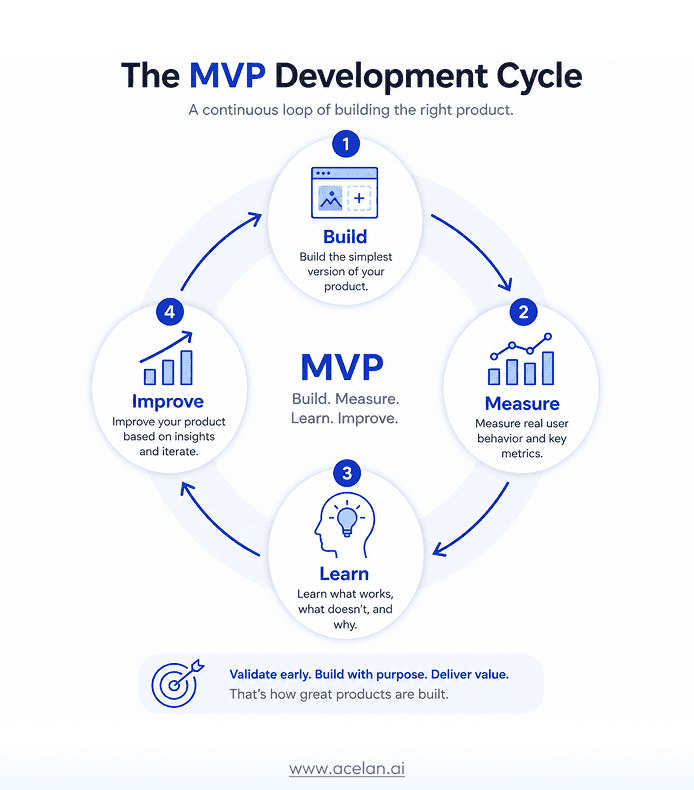
An MVP gives teams a starting point for continuous improvement.
The product can move from:
Build → Measure → Learn → Improve
This type of iterative product development is closely connected with lean and agile approaches.
What Should Be Included in an MVP?
A strong MVP starts with the core product loop, which is the main sequence of actions through which a user receives value.
For example:
Customer finds a service → Books the service → Receives confirmation
Before adding secondary features, make sure this core journey works properly.
Start With One Core Problem
Clearly define the problem the MVP needs to solve. Instead of starting with a long feature list, start by identifying the user's main pain point.
Identify the Primary User
Understand who will use the product first, what problem they face, and how they currently solve it.
Define the Essential User Journey
Map the shortest journey that delivers the product's main value. For a customer support platform, this might be:
Customer submits an issue → Support agent receives it → Agent responds → Customer gets a resolution
Select Only Essential Features
Ask of every proposed feature:
Does this help solve the core problem or help us learn something important?
If not, it may belong in a later release.
Keep the Technical Foundation Reliable
A focused MVP still needs the basics required for a dependable product, such as:
- Secure authentication
- Reliable data storage
- Error handling
- QA testing
- Monitoring
- Appropriate deployment practices
An MVP should be minimal in scope, not careless in execution.
MVP vs Prototype vs Proof of Concept
MVP, prototype, and Proof of Concept (PoC) are often used interchangeably, but they solve different problems.
| Factor | MVP | Prototype | PoC |
|---|---|---|---|
| Main purpose | Validate a product with users | Explore an idea or user experience | Test technical feasibility |
| Working product | Usually yes | Not always | Usually limited |
| Real users | Often | Sometimes | Usually no |
| Business validation | Strong focus | Limited | Limited |
| Technical validation | Important | Limited | Primary focus |
| Typical outcome | Usable early product | Design or interactive model | Technical demonstration |

In simple terms:
- Prototype: "Could this experience work?"
- PoC: "Can we technically build this?"
- MVP: "Will this product provide real value to users?"
A project may use all three, such as:
PoC → Prototype → MVP → Full Product
But this is not a fixed process. The right starting point depends on what the business needs to validate.
MVP vs Full Product: What Changes After Validation?
An MVP is not necessarily the final version of the product.
Once the core idea has been validated, the product can evolve based on actual user needs.
That may include:
- Additional features
- More integrations
- Improved scalability
- Better performance
- Stronger security controls
- Advanced automation
- More detailed analytics
- Mobile applications
- Administrative tools
- Improved customer support
- Infrastructure improvements
The important difference is that these decisions are now informed by evidence from the market rather than assumptions made before launch.
When Should You Stop Calling It an MVP?
There is no universal feature count that turns an MVP into a full product.
A product has generally moved beyond the MVP stage when the business has validated its core value proposition and is now focused on broader growth, scale, reliability, and product expansion.
In other words, MVP is a stage in product development, not a permanent label.
Real-World Examples of Minimum Viable Products
Many well-known companies are often discussed in the context of MVPs, but their early product stories should be understood in their historical context rather than treated as universal formulas.
For example, Atlassian describes Amazon's early focus on online books and Uber's early SMS-based service as examples of starting with a focused product before expanding.
The larger lesson is more useful than the company names:
Start with a focused problem, provide real value, learn from users, and expand based on evidence.
Acelan's MVP Experience: From Fragile Codebase to Funded Product
Acelan's own experience provides a more practical example of what MVP work can look like in the real world.
A few months ago, an Australian SaaS startup approached Acelan while its product was still in an early and fragile state.
The startup already had an AI-generated codebase. Technically, the product worked, but the codebase contained bugs, edge cases, and inconsistencies that made it unsuitable for real users.
The challenge was not to build a completely new product from scratch. The priority was to stabilize what already existed and turn it into a reliable MVP.
Acelan assigned a focused team consisting of one developer and one QA engineer.
Together, they worked through the product systematically:
- Identified and fixed bugs
- Tested important user flows
- Handled edge cases
- Improved product stability
- Iterated based on testing
- Prepared the platform for real-world use
The result was a clean, demo-ready MVP.
That MVP became an important milestone for the founders. They subsequently secured investment from Antler, a global early-stage venture capital firm. Following the investment, the product continued to evolve, with Acelan supporting backend development, new feature releases, ongoing maintenance, and Quality Assurance.
The important lesson is not that every MVP will lead to funding.
It is this:
An MVP does not need to contain everything you eventually want to build. It needs to be stable enough to demonstrate the core product, provide value, and help the business decide what comes next.
This is also why development and quality assurance should not be treated as separate concerns during MVP development. A product can have a limited feature set while still needing to be reliable, secure, and usable.
What Are the Common Mistakes When Building an MVP?
MVP development can reduce risk, but only when the MVP itself is planned properly.
Trying to Build the Full Product
One of the most common mistakes is putting too many features into the first release.
The result is usually a larger budget, longer timeline, and slower learning.
A useful question is:
"What can we postpone without preventing users from experiencing the core value?"
Confusing MVP With a Poor-Quality Product
An MVP is not an excuse for broken functionality.
Users should still be able to complete the main workflow reliably.
Poor quality can make it difficult to understand whether users rejected the idea or simply had a bad experience using it.
Building Features Without a Clear Hypothesis
Every major MVP feature should have a reason for existing.
If a feature is included simply because someone thinks "users might want it," it should be questioned.
Ignoring User Feedback
Launching an MVP and then continuing with the original roadmap without learning from users defeats much of the purpose.
Feedback should influence what gets improved, removed, or added.
Skipping QA
A limited feature set still needs testing.
QA can identify:
- Broken workflows
- Edge cases
- Validation issues
- Security problems
- Device or browser issues
- Performance problems
Overengineering the Architecture
The opposite problem is building an architecture designed for a scale the product has not yet reached.
The architecture should be capable of supporting the expected product direction without introducing unnecessary complexity on day one.
Choosing Technology Before Defining the Problem
Technology should support the product objective.
Starting with "Which framework should we use?" before understanding the users and business problem can lead to unnecessary technical decisions.
When Should You Build an MVP?
An MVP can be a strong choice when the business has an idea worth testing but still has important questions to answer.
Build an MVP If:
- You have a clear problem to solve.
- You know who your initial users are.
- Important product assumptions still need validation.
- Building the full product would require significant investment.
- You want feedback from real users.
- You are unsure which features will create the most value.
- You need a working product to demonstrate the concept.
Consider Another Approach If:
- The product has already been thoroughly validated.
- You only need to test whether a specific technology works.
- A simple prototype can answer your immediate question.
- An established SaaS product already solves the problem effectively.
- The main requirement is visual or UX validation rather than product validation.
The right question is not:
"Does every startup need an MVP?"
It is:
"What do we need to learn before making the next major investment?"
If an MVP can answer that question, it may be the right approach.
What Happens After an MVP?
The MVP is usually the beginning of the next learning cycle, not the end of development.
A common path looks like:
MVP → User Feedback → Product Decisions → Iteration → Growth → Scale
Once users begin interacting with the product, the team can look at:
- Which features are being used
- Where users stop during the journey
- Which problems users report
- Which features create the most value
- What users are willing to pay for
- What needs to change before wider adoption
The product roadmap can then be adjusted based on those findings.
Product Improvements
The next stage may involve adding or improving:
- High-value features
- Integrations
- Analytics
- Automation
- Performance
- Security
- User experience
- Infrastructure
Continued QA and Engineering
As usage grows, engineering requirements often change.
A product that works well for 50 users may need different infrastructure and monitoring when it reaches 5,000 users.
This is why post-MVP development should consider both product feedback and technical requirements.
For some businesses, the same development partner that helped stabilize or launch the MVP can continue supporting the product as it grows. This can reduce the time spent transferring product knowledge between different teams.
Final Thoughts: An MVP Is About Learning, Not Just Building
An MVP is more than a smaller version of a final product. It is a focused way to test an idea, understand user needs, and make better product decisions before expanding the scope.
Before starting development, ask:
- What problem are we solving?
- Who are we solving it for?
- What is the smallest useful product we can test?
- What do we need to learn?
- How will we measure the results?
Once these questions are clear, defining the MVP becomes much easier.
For businesses evaluating a new software idea, the first step does not always have to be coding. A clear problem, target user, and validation goal should come first. From there, the right MVP scope can be defined and developed with much greater confidence.
Talk to Acelan about your product idea
From idea to launch, we build secure, scalable, and user-focused software, web, mobile, or enterprise.
Frequently Asked Questions About MVPs
What does MVP mean?
MVP stands for Minimum Viable Product. In business and software development, it is an early version of a product with enough functionality to solve a core problem and test the idea with real users.
What does MVP stand for?
In business and software development, MVP means Minimum Viable Product. In sports, MVP commonly means Most Valuable Player.
What is a Minimum Viable Product in business?
A Minimum Viable Product allows a business to test an idea with real users before investing heavily in a complete product. It can help validate customer demand, understand user needs, and identify which features should be developed next.
What is MVP in software development?
An MVP in software development is a working version of a digital product focused on its core functionality. It should provide enough value for users to test the main product idea while leaving non-essential features for later releases.
What are the benefits of an MVP?
An MVP can help businesses validate ideas earlier, collect user feedback, reduce initial product risk, prioritize features, and make decisions based on real-world usage rather than assumptions.
Is an MVP a finished product?
No. An MVP is an early product version designed for validation and learning. Once the core idea is validated, the product can continue through further development, scaling, and improvement.
What is the difference between an MVP and a prototype?
A prototype is generally used to explore an idea, design, or user experience. It may not contain working software.
An MVP is designed to provide actual product value and generate learning from users.
For example, a clickable Figma design could be a prototype, while a working web application that allows users to complete the product's core task could be an MVP.
How does Acelan help businesses with MVP development?
Acelan works with startups and growing businesses on software products from early product stages through continued development.
The approach focuses on understanding the core problem, defining the right scope, building the essential functionality, testing the product properly, and improving it based on real feedback.
Acelan has also worked with products that were already partially built but needed development and QA support before they were ready for real users. In one recent project, an Australian SaaS startup came to Acelan with an AI-generated codebase that was technically functional but affected by bugs and inconsistencies. A focused developer and QA team helped stabilize the product until it reached a clean, demo-ready MVP stage.
What’s New
At Acelan
Your guide to emerging tech trends, digital trends, strategies, and stories that define what’s current and what’s next!