
What Is Custom Software Development? Benefits, Cost Factors, Examples & More
Understand what custom software development is, why it matters, its benefits, cost factors, and real-world examples for modern businesses.

Satyam Hardiya
March 24, 2026
What Is Custom Software Development? A Complete Guide for Business Leaders
You may have discussed five project management tools, and none of them fit the way your team actually functions. Or you may have a complex sales process, such that all your CRM tools that you are showing them only allow you to shape your workflow around the software logic, and not vice versa. Sound familiar? That stress, between the software there is and the process your business really runs, is the exact issue that custom software development was developed to address.
This guide includes all you need to know about custom software development: what it is, why it is different than off-the-shelf software, the cost considerations, how it is accomplished, and how you should determine whether it is the correct investment to make in your business today.
What Is Custom Software Development?
Custom software development is defined as the process of creating, developing, testing, and maintaining software tailored to your organization or user as opposed to the large market. Rather than buying a product that is designed to support thousands of businesses at the same time, the organization commissioning the system receives a system that is designed specifically to meet its workflows, data model, types of users, and business logic.
This difference is more than it sounds. Off-the-shelf software is designed to support the common use case. It deals with what most businesses require the majority of the time. Custom software takes care of what is needed by your business at any given moment, both the edge cases, the integrations with your current systems, and the workflows that your business or operating model makes truly unique.
The outcome is a customized solution that will not force the business to fit around the software. The software fits in the business.
Businesses typically choose custom software to:
- Automate internal processes that standard tools cannot handle
- Connect multiple systems into one smooth workflow
- Meet strict security or compliance requirements
- Support long-term growth without depending on vendor limitations
What Is Custom Software?
Custom software is software built only for your business.
It is designed to match how your team works, how your data flows, and how your customers interact with your systems. The two terms are worth separating. Custom software refers to the finished product, the application or system delivered. The act of creating software is known as custom software development. The custom software is like a custom CRM developed to support a relationship management workflow of a particular bank. The engineering effort that resulted in it is the custom software development services.
The global custom software development market is valued at approximately $50.9 billion in 2026, with a projected CAGR of 17.9% to 22.6% through 2030, according to Grand View Research. That trajectory reflects a structural shift in how businesses approach technology, not as something they subscribe to, but as something they own and control.
Custom Software vs. Off-the-Shelf Software: Key Differences
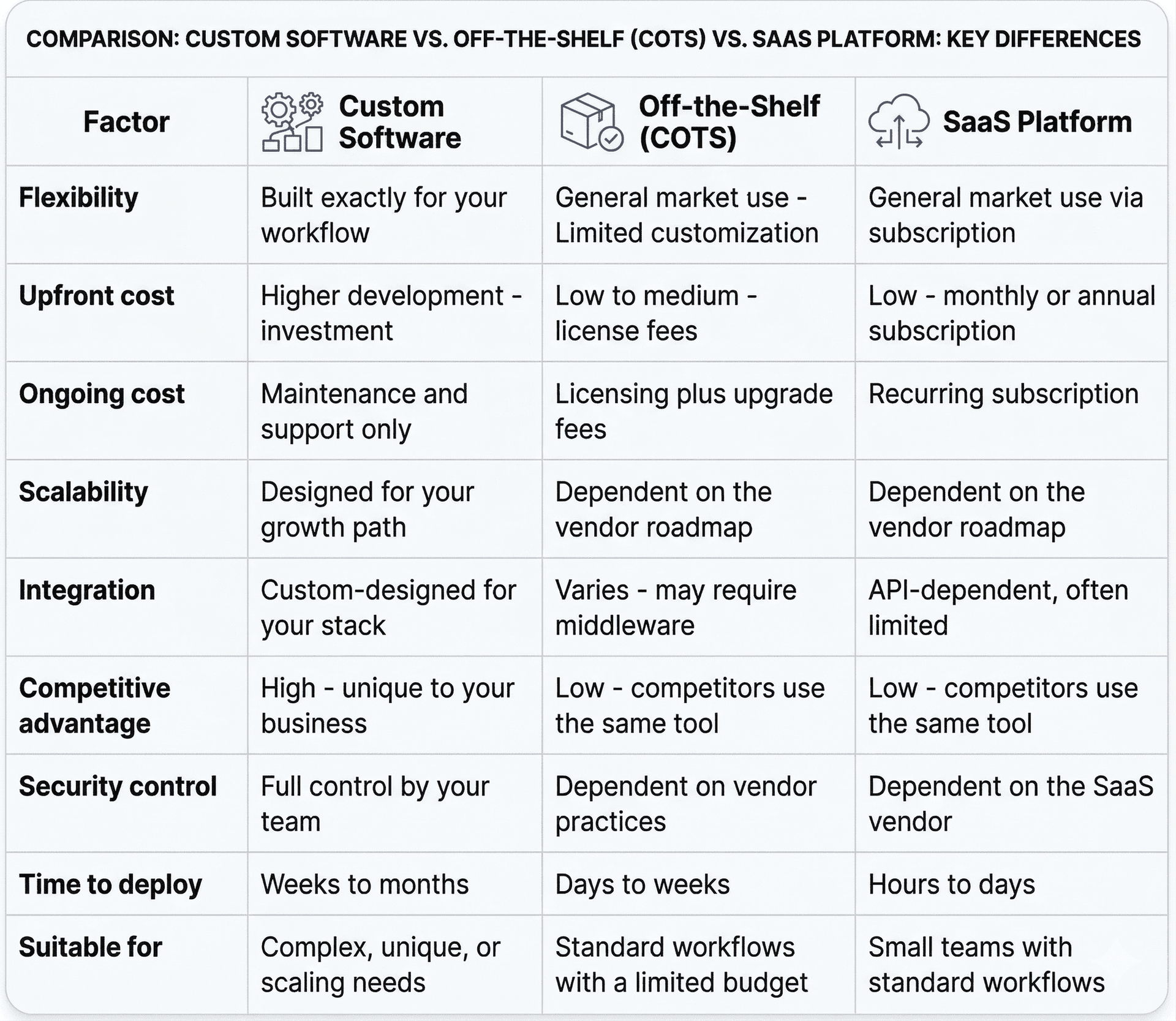
The right choice depends entirely on how unique your problem is. A business running standard project management workflows rarely needs custom software. A logistics company managing 200 warehouse locations with proprietary routing logic almost certainly does.
Real-World Examples of Custom Software by Industry
| Industry | Business Problem | Custom Solution Built | Outcome |
|---|---|---|---|
| Fintech and Banking | Off-the-shelf banking apps could not support multi-currency lending logic or custom credit scoring rules | Custom core banking system with proprietary credit scoring engine and compliance controls built in | Full control over lending rules, faster product iteration, and regulatory compliance by design |
| Healthcare | Clinic needed to connect EHR, billing, and appointment scheduling; no single COTS product handled all three | Custom patient management platform with integrated HL7 data layer across all three systems | Reduced administrative time significantly, eliminated triple data entry, and passed HIPAA audit |
| E-Commerce and Retail | Standard loyalty software could not handle tiered, behavior-based rewards logic tied to purchase history | Custom loyalty engine integrated with POS, mobile app, and email marketing platform | Substantial increase in repeat purchase rate within six months of launch |
| Logistics and Supply Chain | Warehouse operations relied on multiple disconnected spreadsheets and manual handoffs between teams | Custom warehouse management system with barcode scanning, real-time inventory tracking, and carrier integration | Reduced fulfillment errors significantly, enabled same-day shipping capability for priority orders |
| Legal Technology | Legal teams need matter management with custom billing workflows not available in off-the-shelf practice management tools | Custom matter management platform integrated with document management and billing systems | Hours saved per lawyer per month on administrative tasks, with improved billing accuracy |
| Construction | Project managers tracking site progress across 40 locations using spreadsheets and email chains | Custom project management platform with milestone tracking, subcontractor management, and photo documentation | Reduced project reporting time and improved client communication across all active sites |
| Education | An online learning platform needed adaptive content delivery based on student performance data | Custom LMS with AI-driven content sequencing and instructor analytics dashboard | Improved course completion rates and reduced student dropout in the first term after launch |
View Acelan's project case studies
Why Custom Software Development Is Important
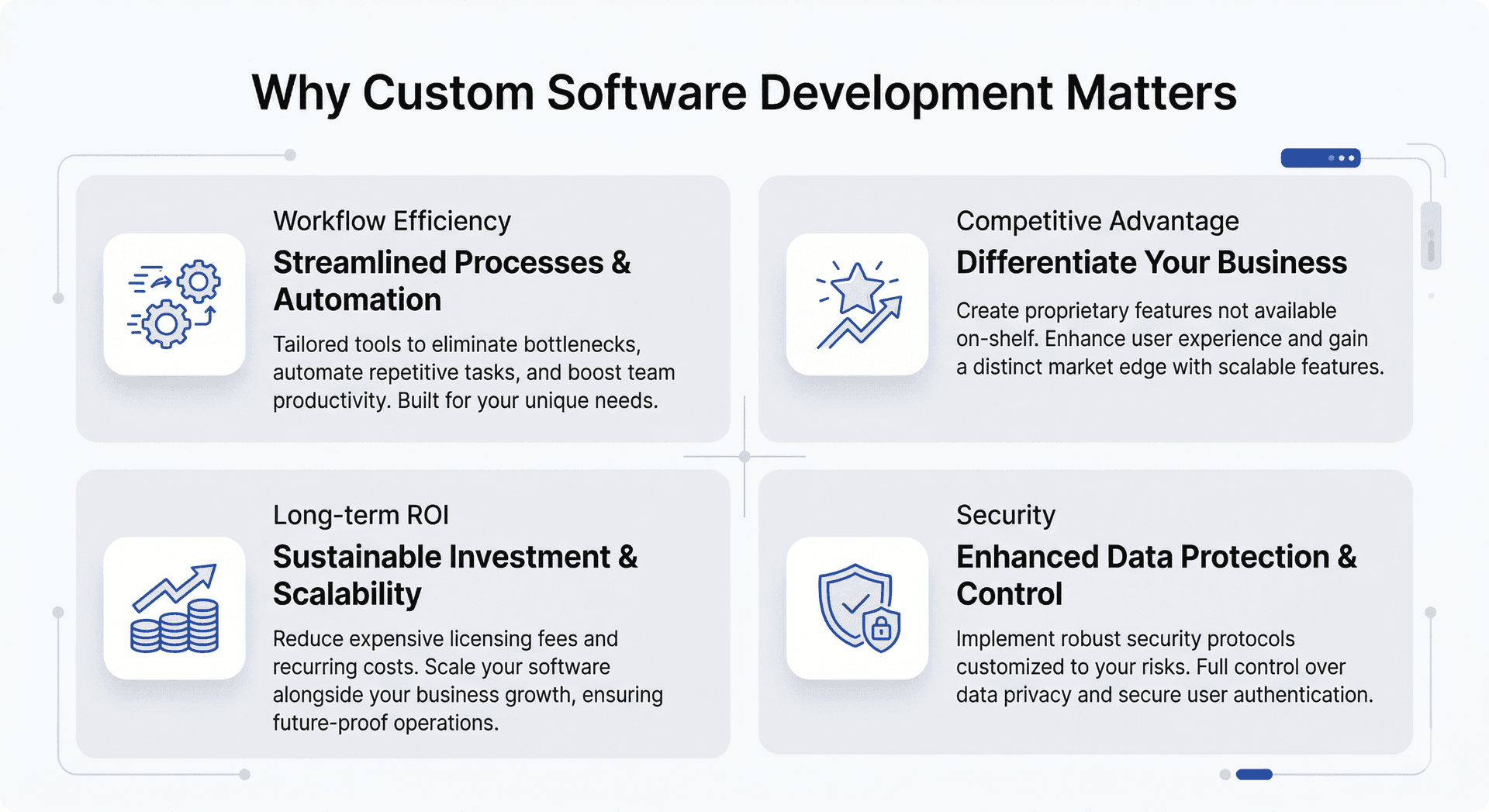
Eliminates workflow friction
When software does not match how a team works, people build workarounds, shadow spreadsheets, manual steps, and duplicated data entry. Custom software removes this category of problem entirely.
Builds a durable competitive advantage
A business running on off-the-shelf tools is running on the same tools as its competitors. Proprietary operational software built around unique process logic is genuinely difficult to replicate.
Delivers stronger long-term ROI
Upfront custom development costs more than a SaaS subscription. But total cost of ownership over time often favors custom software.
Reduces security exposure
Custom software reduces the shared vulnerability surface compared to SaaS platforms.
When Should Your Business Choose Custom Software Development?
Custom software development is not the right answer for every situation. Here is a clear decision framework for evaluating whether it makes strategic sense, and when it does not.
| Custom Software Development Is Right for You If | Custom Software May Not Be the Right Choice If |
|---|---|
| Your core business process is unique and no off-the-shelf product maps to it accurately. | Your workflows are standard and a well-established SaaS tool covers them effectively. |
| You need deep integration between systems that existing platforms cannot natively achieve. | Your team is under ten people and speed-to-market is more important than workflow optimization right now. |
| You are building a digital product, a SaaS platform, marketplace, or app, to sell to your own customers. | Your budget is under $15,000 and the timeline is under four weeks; off-the-shelf is the pragmatic starting point. |
| You operate in a regulated industry where compliance controls must be architected into the system. | The problem you are solving is already solved well by an established product used by thousands of similar businesses. |
| You have validated product-market fit and need to scale a workflow that is becoming a bottleneck. | You are pre-validation and need to test an idea quickly; a no-code MVP may be the right starting point. |
| Protecting your proprietary operational logic from competitors is a strategic priority. | You do not have internal capacity to manage a software product long-term after it is built. |
The Right Starting Question
Before choosing any software approach, start by asking one question: Is the process I am trying to solve genuinely unique to how my business operates? If the answer is yes, and solving it creates a measurable competitive or operational advantage, custom development is worth evaluating. If you are still validating an idea or testing customer demand, an MVP can help validate the concept before committing to full custom software development. If the answer is no, an established tool is usually the better choice, allowing you to focus engineering investment on what is genuinely differentiated.
Cost Factors in Custom Software Development
Several factors move a project toward the higher end of any given cost range:
-
Team geography and day rate — Development teams in the US and the UK generally charge higher rates than teams in Eastern Europe, Latin America, or South Asia. However, quality can vary significantly across regions, so rates should always be evaluated alongside proven experience and a strong delivery track record.
-
Number and complexity of integrations — Every third-party system that needs to exchange data increases the effort required for architecture, development, testing, and long-term maintenance.
-
Complexity of the data model and business logic — There is a significant difference in engineering effort between a simple content management application and a multi-currency financial settlement platform with advanced business rules.
-
UI and UX design scope — Fully custom interfaces, comprehensive design systems, responsive layouts, and accessibility compliance all add time and cost to the design and development process.
-
Post-launch support model — Ongoing maintenance, infrastructure monitoring, security updates, bug fixes, and feature enhancements are typically separate from the initial development cost and should be planned as part of a long-term roadmap.
Get a detailed project estimate
From idea to launch, we build secure, scalable, and user-focused software — web, mobile, or enterprise.
How Custom Software Development Works
Custom software development follows a structured process to reduce risk and ensure the final product actually works in real-world conditions.
The 5 Phases of the Software Development Lifecycle (SDLC)
Requirement Analysis
Every successful software project begins with understanding the problem before proposing a solution. During this phase, developers, business analysts, and stakeholders work together to identify business goals, user needs, functional requirements, and technical constraints. The outcome is a clear project roadmap that reduces misunderstandings and prevents expensive changes later in development.
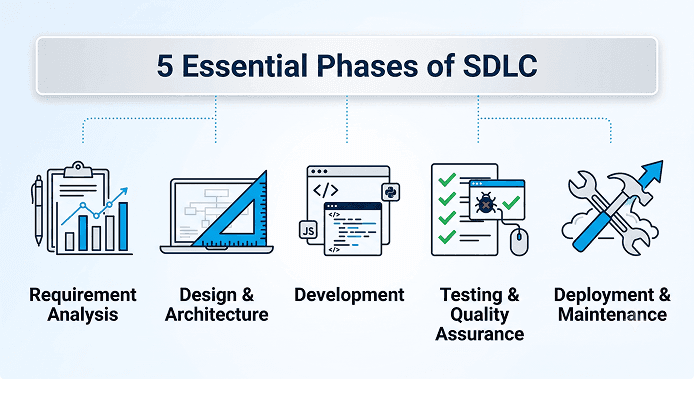
Design & Architecture
Once the requirements are finalized, the project moves into planning the system's structure. This includes designing user interfaces, defining the software architecture, planning databases, mapping user journeys, and determining how the application will integrate with third-party services. Well-planned architecture improves scalability, security, maintainability, and long-term performance.
Development
During the development phase, engineers begin writing the application code based on the approved designs and specifications. Modern development teams typically follow Agile methodologies, delivering features in small iterations with regular reviews and stakeholder feedback. This approach helps ensure the final product remains aligned with evolving business requirements while reducing development risks.
Testing & Quality Assurance
Before software reaches users, it undergoes comprehensive testing to verify quality and reliability. Quality Assurance (QA) teams evaluate functionality, performance, security, usability, and compatibility across devices and browsers. Identifying and resolving issues before deployment is significantly more cost-effective than fixing problems after launch.
Deployment & Maintenance
After testing is complete, the software is deployed to the production environment where end users can access it. However, deployment is not the end of the lifecycle. Ongoing maintenance includes monitoring system performance, applying security updates, fixing bugs, improving functionality, and adding new features as business requirements evolve. Continuous maintenance ensures the software remains secure, stable, and valuable over time.
Build Software That Works the Way Your Business Actually Works
Custom software development is not a technology decision in isolation. It is a strategic investment in operational capability, competitive differentiation, and long-term product ownership.
It makes the most sense when your process is unique, your integration requirements are complex, or your business is building a digital product as its core offering.
At Acelan, we work with startups and growing businesses to design, build, and scale custom software from concept to production, with transparency on scope and trade-offs at every stage.
If you are evaluating custom development for your next project, talk to our team first. We will tell you directly whether custom software is the right path for where you are right now.
Schedule a free discovery call
Frequently Asked Questions
What is the meaning of custom software development?
Custom software development is the process of building software for a specific organization rather than for general commercial sale. It is used when existing products do not address a business's unique operational requirements or when building proprietary software capability is itself a strategic advantage.
What are examples of custom software?
Common examples include a fintech company's proprietary credit scoring engine, a hospital's integrated patient management platform, a logistics company's custom warehouse management system, and a restaurant chain's loyalty app with behavior-based rewards logic. The common thread is that no commercially available product solved the problem adequately.
What is another name for custom software?
Bespoke software is the most common synonym, particularly in UK markets. Purpose-built software, proprietary software, and tailor-made software are also used. The terminology varies by market, but the meaning is consistent: software designed for one organization's specific requirements.
What is the difference between custom software and SaaS?
SaaS is a delivery and pricing model, cloud-hosted, subscription-based, used by many customers simultaneously. Custom software is a development approach built for one organization's exclusive use. A business can build its own SaaS product using custom development. The key distinction is ownership: custom software is owned by the organization that commissioned it.
What are the three main types of software?
The three main types of software are custom software, off-the-shelf software, and SaaS-based software. Custom software is built for one business, off-the-shelf software is sold to many customers with limited customization, and SaaS software is accessed through subscriptions and hosted in the cloud.
Does Acelan mainly work on custom software development projects?
Yes. More than 80% of Acelan’s work focuses on custom software development. This includes building software tailored to specific business processes, system integrations, and long-term digital strategies rather than delivering generic, one-size-fits-all solutions.
What’s New
At Acelan
Your guide to emerging tech trends, digital trends, strategies, and stories that define what’s current and what’s next!