
How Much Does It Cost to Build an MVP in 2026? Complete Pricing Guide
Explore MVP cost ranges, key cost factors, hidden expenses, and practical ways to plan your budget.

Satyam Hardiya
September 2, 2026
MVP development cost can start at around $2,000 for a tightly scoped product and can exceed $150,000 for complex AI, SaaS, enterprise, multi-platform, or regulated applications. The actual cost depends less on the word "MVP" and more on what you need to build, test, integrate, and support.
At Acelan, we have seen how very different MVP requirements can lead to very different budgets. A focused MVP may need only one core workflow and essential functionality, while a production-ready SaaS or AI product can require multiple user roles, integrations, stronger security, QA, analytics, and scalable infrastructure.
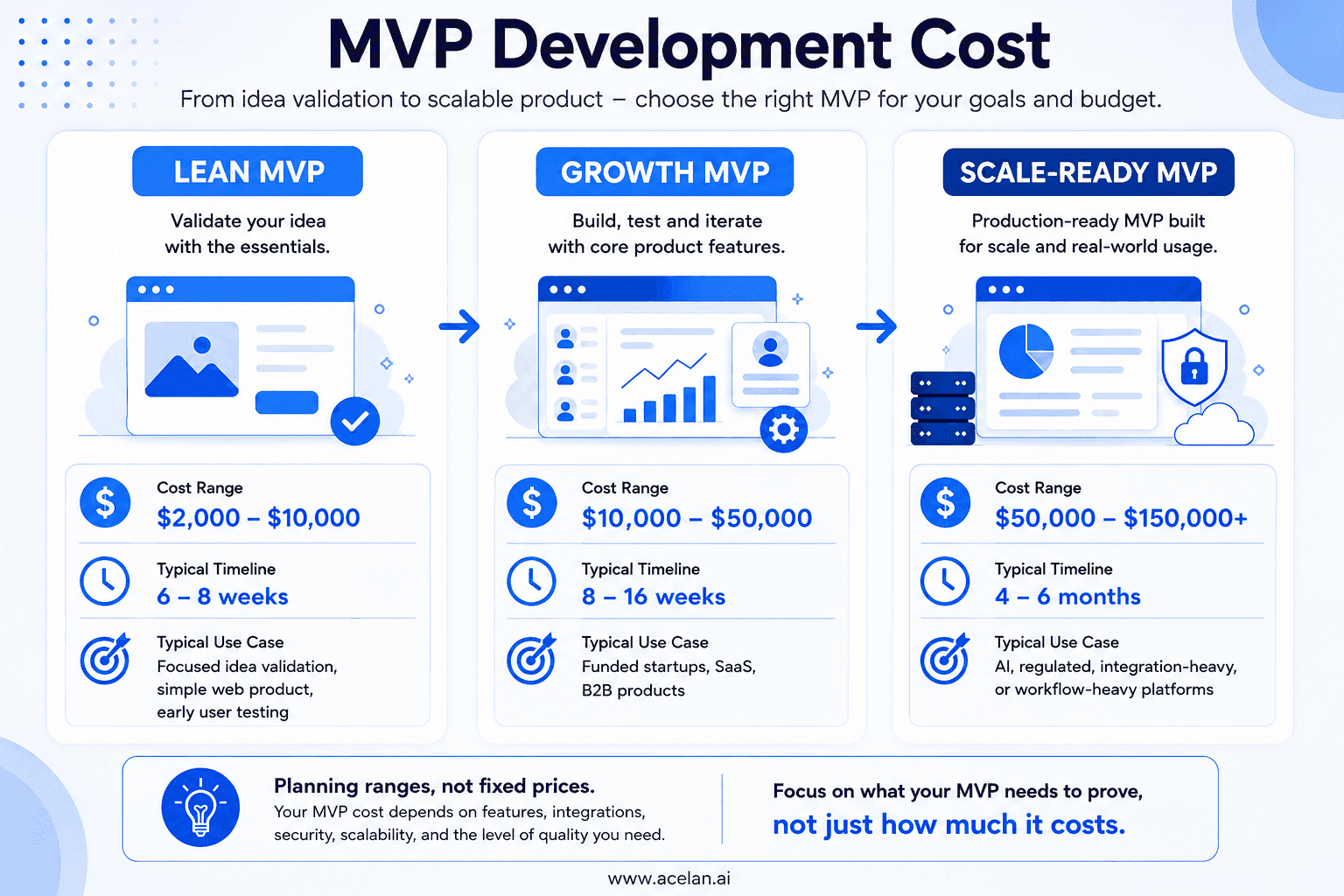
For practical planning, a useful way to look at MVP costs in 2026 is:
| MVP Type | Cost Range (2026) | Typical Timeline | Typical Use Case |
|---|---|---|---|
| Lean MVP | $2,000–$10,000 | 6–8 weeks | Focused idea validation, simple web product, early user testing |
| Growth MVP | $10,000–$50,000 | 8–16 weeks | Funded startups, SaaS, B2B products |
| Scale-Ready MVP | $50,000–$150,000+ | 4–6 months | AI, regulated, integration-heavy, or workflow-heavy platforms |
These are planning ranges, not fixed prices. A very focused MVP can be built around the lower end, while a product with more complex workflows, integrations, security requirements, or scalability needs can move quickly into a higher budget.
Current 2026 market examples also show why there is no single "average" MVP price. Published estimates for SaaS MVP development range from low-thousands for very lean products to tens of thousands for production-ready SaaS, depending on the scope and what the provider includes.
The important question is therefore not simply:
"How much does an MVP cost?"
It is:
"What does your MVP need to prove, and what is the minimum reliable product required to prove it?"
That distinction can make a significant difference to your budget.
Why MVP Development Cost Varies So Much
Not every MVP is the same.
A simple product with one core workflow can cost far less than a SaaS platform with multiple user roles, payment processing, third-party integrations, or AI features.
The biggest factors that affect MVP development cost are:
- Feature scope and complexity
- Platform: web, mobile, or both
- Third-party integrations
- Architecture and scalability
- Security and compliance
- QA and testing
- Development team and location
For example, a basic login system may require relatively little development. A login system with multiple roles, SSO, permissions, two-factor authentication, and audit logs requires much more engineering.
This is why comparing MVP quotes only by the number of features or hourly rate can be misleading.
MVP cost is driven by complexity and engineering effort, not simply by the number of features.
Have an MVP idea?
Get a clear estimate based on your product scope and requirements.
What Actually Goes Into an MVP Development Budget?
The development quote is only one part of an MVP budget.
A reliable MVP also needs product planning, UI/UX, QA, deployment, infrastructure, and project coordination.
As a practical planning framework, the budget can be distributed approximately like this:
| Cost Area | Approx. Share | What It Covers |
|---|---|---|
| Development | 50–60% | Frontend, backend, database, APIs, core functionality |
| Product & UI/UX | 10–15% | User flows, wireframes, interface design |
| QA & Testing | 10–15% | Functional, regression, integration and user-flow testing |
| DevOps & Infrastructure | 8–12% | Deployment, CI/CD, environments and monitoring |
| Project Management & Communication | 5–8% | Planning, coordination, demos and scope management |
These percentages should be treated as illustrative planning ranges, not universal industry standards. Published MVP and SaaS cost guides use different allocations depending on the type of product and services included. For example, Datasoft currently reports 55–65% engineering for its SaaS engagements, while other providers use different distributions across development, design, QA, discovery, and launch.
The point is not to make every MVP fit these percentages. The point is to help founders understand that the development line is not the entire MVP budget.
Development: Around 50–60%
Development is usually the largest part of the budget.
It can include:
- Frontend development
- Backend development
- Database development
- APIs
- Business logic
- Authentication
- Core workflows
The percentage can increase when the product has complex backend logic, multiple integrations, real-time functionality, or higher scalability requirements.
Product and UI/UX: Around 10–15%
This covers the work required to turn the product idea into a clear user experience.
It can include:
- User journeys
- Wireframes
- UI design
- Responsive layouts
- Design systems
- Core interactions
Good product design also helps developers understand exactly what needs to be built and can reduce rework later.
QA and Testing: Around 10–15%
QA helps verify that the product works as expected across different situations, not just during a developer's own testing.
It can cover:
- Core user journeys
- Browser testing
- Device testing
- Integration testing
- Payment flows
- Permissions
- Edge cases
- Regression testing
For an MVP, QA is particularly important because early users are often the first people to expose problems that were missed during development.
DevOps and Infrastructure: Around 8–12%
This can include:
- Development and production environments
- CI/CD
- Cloud deployment
- Monitoring
- Backups
- Logging
- Infrastructure configuration
The exact requirement depends on the product and expected usage.
Project Management and Communication: Around 5–8%
This covers the work required to keep development aligned with the agreed scope.
It may include:
- Sprint planning
- Requirement clarification
- Progress updates
- Product demos
- Coordination
- Scope management
This part of the budget can look small on paper, but poor coordination can create significant rework later.
The Biggest MVP Cost Factors in 2026
The budget breakdown above tells you where the money goes. The following factors explain why one MVP costs more than another.
Feature Scope and Complexity
Feature scope is often one of the biggest cost drivers.
Adding a feature does not always mean adding one screen. A single feature may require frontend work, backend logic, database changes, APIs, error handling, and testing.
For example, "booking" could involve:
- Availability
- Booking confirmation
- Payments
- Cancellation
- Notifications
- Refunds
- Admin controls
The feature may appear as one item in a proposal, but the engineering behind it can be much larger.
Platform Requirements
A web-only MVP is different from a product that requires:
- Web
- iOS
- Android
- Admin panel
If mobile is not essential for validating the initial business idea, starting with one platform can help control the first development budget.
Third-Party Integrations
Payments, CRM systems, ERP platforms, maps, email, SMS, analytics, and AI services all add integration and testing work.
Architecture and Scalability
A simple internal tool and a multi-tenant SaaS platform have very different architecture requirements.
The goal should be to build an architecture that is reliable enough for the MVP without paying for unnecessary complexity too early.
Security and Compliance
Products handling sensitive information or operating in regulated industries may require additional:
- Authentication controls
- Access management
- Encryption
- Logging
- Security testing
- Compliance preparation
QA and Testing Requirements
The more critical the product, the more important it becomes to test different workflows, devices, integrations, permissions, and edge cases before launch.
Development Team and Location
The team structure and location can influence hourly rates and total project estimates.
However, the lowest hourly rate does not automatically mean the lowest final cost.
A team that requires significant supervision or produces more rework can ultimately cost more than a higher-priced team with a stronger delivery process.
How Much Does a SaaS MVP Cost in 2026?
SaaS products generally require more than a simple website because users need accounts, private data, permissions, subscriptions, and ongoing access to the application.
For planning purposes:
| SaaS MVP Type | Illustrative Cost Range | Typical Scope |
|---|---|---|
| Focused SaaS MVP | $5000–$15,000 | One core workflow, authentication, basic dashboard |
| Production SaaS MVP | $15,000–$50,000 | Multi-user workflows, billing, integrations, analytics |
| Complex SaaS MVP | $50,000–$150,000+ | Advanced multi-tenancy, AI, enterprise requirements |
These ranges should not be treated as fixed market prices. Current 2026 published SaaS estimates vary considerably. For example, Datasoft currently reports $4,800–$15,000 for a scoped SaaS MVP and $15,000–$30,000 for a production multi-tenant SaaS, while other current guides place more complex SaaS MVPs considerably higher.
The difference usually comes down to what is actually included.
A $10,000 SaaS MVP and an $80,000 SaaS MVP may both be called MVPs, but they are unlikely to have the same:
- Number of workflows
- User roles
- Billing requirements
- Integrations
- Architecture
- QA depth
- Scalability
- Security requirements
That is why founders should always ask for the scope behind the number.
How Much Does an AI MVP Cost in 2026?
AI MVP costs can vary even more because "AI MVP" can describe very different products.
A basic application that connects to an existing AI API is very different from an AI platform requiring:
- Custom data processing
- RAG
- Vector databases
- AI agents
- Model evaluation
- Monitoring
- Large-scale API usage
- Custom workflows
AI can therefore increase both the initial development effort and ongoing operating costs.
AI-Assisted Development vs AI-Powered Product
These are two different things.
AI-assisted development means developers use AI tools to help write code, create tests, document systems, or debug problems.
An AI-powered product means AI is part of the product that customers actually use.
Using an AI coding tool to build a normal SaaS application does not automatically make it an AI product.
This distinction matters when estimating the budget.
How Does the Development Team Affect MVP Cost?
The development team can have a significant impact on the final budget.
| Team Model | Main Advantage | Main Trade-off |
|---|---|---|
| Freelancer | Lower initial cost | Limited capacity and broader responsibility |
| Development agency | Full team and expertise | Higher project cost |
| In-house team | Direct control | Hiring and operating overhead |
| Hybrid team | Flexible expertise | Requires strong coordination |
The right option depends on:
- Product complexity
- Internal technical expertise
- Budget
- Timeline
- Need for QA
- Long-term product plans
A founder with strong technical experience may be able to manage part of the development internally. A non-technical founder building a complex product may need product, design, engineering, and QA support.
Does Developer Location Affect MVP Cost?
Yes, location can affect hourly development rates.
However, location should be treated as one factor, not the entire decision.
For example, current 2026 market guides show significant differences between regional rates.
| Team Location | Illustrative Hourly Range | General Cost Impact |
|---|---|---|
| United States | $80–$150+ | Higher |
| Western Europe | $70–$130 | Higher |
| Eastern Europe | $35–$70 | Moderate |
| LATAM | $30–$60 | Moderate to lower |
| Asia | $20–$45 | Lower |
These are broad market benchmarks, not Acelan's rates.
A lower hourly rate can become expensive if a project experiences:
- Poor communication
- Weak QA
- Rework
- Missed deadlines
- Poor documentation
- Weak project management
When comparing teams, evaluate the total project cost and expected outcome, not just the hourly rate.
How AI Is Changing MVP Development Costs in 2026
AI has changed how software teams approach MVP development.
It can reduce the time required for some repetitive tasks, but it has not removed the need for experienced engineering.
Where AI Can Reduce Development Effort
AI tools can assist with:
- Boilerplate code
- Documentation
- Test generation
- Code suggestions
- Initial prototypes
- Repetitive development tasks
- Debugging assistance
This can help experienced developers move faster.
But faster code generation does not automatically mean a lower total project cost.
Where Human Engineering Still Matters
Human review remains important for:
- Architecture
- Security
- Code quality
- Complex business logic
- Integration reliability
- QA
- Production debugging
- Performance
- Data protection
This is why AI-assisted development is better understood as a way to accelerate engineering, rather than a replacement for engineering.
The AI-Generated MVP Problem Acelan Sees
At Acelan, we have spoken with founders who used AI tools to build significant portions of their MVP themselves.
The experience can be encouraging at first.
A few prompts can generate screens, database models, APIs, or other pieces of functionality. The product may even appear to work.
The problems often become more visible as the product grows.
In conversations with founders, we have encountered common issues such as:
- Inconsistent code
- Bugs
- Unhandled edge cases
- Missing tests
- Difficult-to-maintain architecture
- Integration problems
- Limited production readiness
Some founders reach a point where they are spending more time fixing generated code than moving the product forward.
This does not mean AI should not be used.
If you have development experience, enough time, and guidance from an experienced engineer, AI-assisted development can be a useful way to explore an idea or accelerate early work.
But founders should not confuse generated code with a production-ready product.
Even when AI is used heavily, plan for technical review and proper QA before putting the product in front of real customers.
Built Your MVP With AI?
Let Acelan review your code, fix issues, and get it ready for real users.
Hidden and Post-Launch MVP Costs Founders Should Budget For
The initial development quote is not necessarily the complete MVP budget.
Once the product is live, you may also need to budget for the following.
Hosting and Infrastructure
Depending on your architecture and traffic, you may have costs for:
- Cloud hosting
- Databases
- File storage
- Content delivery
- Monitoring
- Backups
- Logging
Third-Party APIs
External services can create ongoing usage costs.
Examples include:
- Payment processing
- SMS
- Maps
- Analytics
- AI APIs
- Search services
These costs often increase with usage, so they should be considered separately from the one-time development budget.
Maintenance and Security
After launch, software still needs attention.
Maintenance can include:
- Bug fixes
- Dependency updates
- Security patches
- Browser compatibility
- Operating system updates
- Infrastructure changes
- Performance improvements
Post-Launch Iteration
This is one of the most important costs to plan for.
An MVP is built to learn.
Once real users start using it, you may discover that:
- A feature is confusing
- A workflow needs changing
- Users want a different capability
- A planned feature is unnecessary
- A technical limitation needs to be addressed
That is not a failure of the MVP. It is part of the purpose of building one.
Customer Support and Operations
Depending on the product, you may also need resources for:
- Customer support
- User onboarding
- Documentation
- Account management
- Monitoring
- Incident response
How Much Should You Budget Beyond the Initial MVP Build?
Do not treat your development quote as your complete product budget.
A more realistic framework is:
Initial Build + Launch + Infrastructure + QA/Maintenance + Early Iteration
The amount you need to reserve depends on:
- Product risk
- Expected user volume
- Infrastructure requirements
- Industry
- Expected iteration speed
- Available funding runway
Some products may need very little infrastructure at first. Others may have meaningful API, hosting, or AI usage costs from the beginning.
The same applies to iteration. A product entering a fast feedback cycle may need more engineering capacity immediately after launch.
Instead of adding an arbitrary percentage to every project, understand what your first few months after launch are likely to require.
How to Reduce MVP Development Cost Without Cutting Quality
Reducing cost does not mean removing everything that makes the product reliable.
The better approach is to reduce unnecessary scope and rework.
Validate Before Building
Before paying for custom development, determine whether the idea can be tested through:
- Customer interviews
- Landing pages
- Clickable prototypes
- Manual workflows
- No-code experiments
- Design-partner programs
If a cheaper experiment can answer the biggest business question, use it.
Focus on One Core Problem
An MVP should solve a clear problem for a clearly defined user.
If the first release tries to serve five customer types and solve ten different problems, the scope will grow quickly.
Start With One Platform
If your product can be validated through the web, consider starting there rather than building web, iOS, and Android simultaneously.
Add additional platforms once there is a clear reason to do so.
Use Existing Tools Where They Make Sense
You do not need to build everything from scratch.
Existing services can handle areas such as:
- Payments
- Authentication
- Analytics
- Notifications
- Cloud infrastructure
The goal is to custom-build what makes your product different and use reliable existing components where they make sense.
Use AI as an Accelerator, Not a Replacement for Engineering
AI can help developers move faster.
It should not become an excuse to skip:
- Architecture
- Code review
- Security
- Testing
- Documentation
- Production monitoring
The better question is:
Where can AI help us build this faster without increasing the product's technical risk?
Budget QA From Day One
Do not wait until development is finished to think about quality.
Testing alongside development can identify problems before they become expensive rework.
Choose Architecture Based on the Product's Next Stage
Avoid both extremes.
Overengineering: Spending heavily on infrastructure and complexity that the MVP does not need.
Throwaway development: Building so quickly that the product must be rebuilt as soon as users arrive.
A good MVP architecture should support the product's current validation goals while leaving a sensible path for the next stage.
What Should Founders Ask Before Accepting an MVP Quote?
Before comparing development proposals, ask each provider what the price actually includes.
MVP Quote Checklist
- What exactly is included?
- What is excluded?
- Is product discovery included?
- Is UI/UX design included?
- Is QA included?
- What browsers and devices will be tested?
- Are third-party API fees included?
- Is deployment included?
- Who owns the source code?
- What happens after launch?
- How are change requests priced?
- What happens if the scope changes?
- Is documentation included?
- Is security testing included where necessary?
- Who will maintain the product after launch?
Two proposals with the same headline price can represent very different amounts of work.
Also ask the provider to explain what assumptions the estimate is based on.
A reliable estimate should have a clear relationship between the scope and the price.
Acelan's Perspective: What Makes an MVP Budget Worth the Investment?
At Acelan, we believe an MVP budget should be built around learning and product validation, not simply the number of features a team can deliver.
Our approach starts with understanding the product idea, target users, core workflow, and business goal. From there, the scope can be reduced to the functionality that genuinely needs to exist in the first version.
Acelan's current MVP offering covers product discovery and strategy, UI/UX and wireframing, prototyping, development, backend/API work, testing, deployment, and post-launch support.
Budget for Learning, Not Feature Volume
A long feature list does not automatically make an MVP better.
If a feature does not help solve the core problem or provide useful learning, it may belong in a later release.
Build Quality Into the MVP
"Minimum" should describe the scope, not the quality.
Users should still be able to trust the product, complete the core workflow, and use it without constantly encountering avoidable problems.
Treat QA as Part of Development
Testing should not be something that happens only when the product is supposedly finished.
Acelan's development and QA capabilities cover the product journey from ideation and strategy through development, testing, and launch.
Plan for What Happens After Launch
An MVP is rarely the final destination.
Once users start interacting with the product, the business gains information that can guide the next release.
Acelan's MVP approach includes post-launch support and scaling, which allows the product to continue evolving after the initial validation stage.
Not sure what your MVP needs?
We can help you define the right features, scope, and development approach.
Final Thoughts: Budget for Learning, Not Just Building
The answer to "how much does it cost to build an MVP?" is not one fixed number.
A very focused MVP may be built with a relatively small budget, while an AI-powered SaaS platform, marketplace, or regulated product can require a much larger investment.
What matters most is understanding why the cost changes.
Your MVP development cost is influenced by:
- Scope and feature complexity
- Platform requirements
- Architecture
- Integrations
- Security
- QA
- Team structure
- Development location
- AI requirements
- Post-launch needs
The best MVP is not necessarily the cheapest one.
It is the one that gives you enough product quality and real-world learning to make the next business decision with confidence.
If you are planning an MVP, start by defining the problem, target user, core workflow, and assumptions you need to test. Once those are clear, a development team can give you a much more meaningful estimate than a generic "MVP costs $X" figure.
If you already have an MVP idea, partially built product, or AI-generated codebase and want to understand what it would realistically take to bring it to a reliable first release, Acelan can help you evaluate the scope, technical requirements, and next steps.
Frequently Asked Questions
How much does it cost to build an MVP?
The cost depends on what you are trying to validate.
A focused web MVP with one core workflow can cost significantly less than a multi-platform product with complex integrations, billing, AI, or enterprise permissions.
The best way to estimate the budget is to define the core user journey and required functionality first.
Can I build an MVP for under $10,000?
Yes, but the scope usually needs to be very focused.
A budget below $10,000 may be suitable for a narrow validation product, a no-code or low-code MVP, a clickable prototype combined with limited functionality, or a simple custom application.
A complex SaaS platform, marketplace, AI product, or multi-platform application is much harder to fit into that budget without significant compromises.
How much does a SaaS MVP cost?
A focused SaaS MVP may fall around the $5,000 to $15,000 planning range, while more production-ready SaaS products with multi-tenancy, billing, analytics, role-based access, integrations, or enterprise requirements can move into the $15,000 to $50,000+ range.
These are planning ranges rather than fixed prices. Current 2026 published estimates vary considerably based on scope and what the provider includes in its definition of an MVP.
How much does an AI MVP cost?
There is no single AI MVP price.
An application using a basic AI API may have relatively limited additional engineering requirements. A more advanced AI product may need data preparation, RAG, vector search, evaluation, monitoring, model management, and ongoing API usage.
The cost therefore depends more on the AI use case and technical requirements than simply on the fact that the product uses AI.
Does AI reduce MVP development costs?
AI can reduce development effort for some tasks, including code assistance, documentation, test generation, prototyping, and repetitive development work.
However, AI-generated code still needs appropriate architecture, review, security checks, testing, and debugging.
AI can accelerate development, but it does not remove the engineering work required to make a product reliable.
What is the biggest factor affecting MVP development cost?
Scope and complexity are usually among the biggest factors.
However, the real cost is determined by how each part of the product behaves. A simple feature may require little work, while a feature involving multiple user roles, APIs, permissions, payments, notifications, and edge cases can require considerably more engineering.
Platform, integrations, security, architecture, team structure, and QA can also significantly affect the final budget.
What costs should I budget for after building an MVP?
In addition to development, consider hosting and infrastructure, third-party APIs, maintenance, security updates, monitoring, customer support, and post-launch product iteration.
An MVP is designed to generate learning from real users, so some budget for improvements after launch is usually sensible.
Ready to Build Your MVP?
Let's discuss your idea and find the right way to bring it to market.
What’s New
At Acelan
Your guide to emerging tech trends, digital trends, strategies, and stories that define what’s current and what’s next!